Foundation Inspection Checklist
June 21, 2026
Free download · no email required
Foundation Inspection Checklist
Excavation, reinforcement and pour checks before concrete goes in and the work is buried.
Prefer not to retype it? SiteAudit runs this on your phone offline, attaches photos to every line and exports a signed PDF before you leave site. See all templates.
Foundations carry the entire building, and almost every defect in them is concealed the moment concrete is poured. That makes foundation inspection one of the highest-stakes checks on any project — and a genuine hold point. Get it wrong and the consequences range from cracking to structural failure, with remediation that's enormously expensive or impossible.
This checklist covers the key foundation inspection points. Always work to the structural engineer's drawings, the specification, and building control requirements, which take precedence over any general guidance.
Before excavation
- Setting out checked against drawings — position, dimensions, and orientation.
- Existing and buried services located and avoided.
- Ground investigation/soil report reviewed and understood.
Excavation and formation
- Excavation to correct depth, width, and dimensions per drawings.
- Founding stratum reached and matches the assumed ground conditions — a key check; if the ground differs from the design assumption, the engineer must be informed.
- Formation level, clean, and free of loose material, water, and debris.
- Sides stable and supported as required (this is also a safety hold point).
- No soft spots, tree roots, or made ground at formation.
Before concrete (the critical hold point)
- Reinforcement: correct bar size, number, spacing, and grade per drawings.
- Laps, anchorage, and starter bars correct.
- Cover to reinforcement correct, with spacers in place.
- Any cast-in items (holding-down bolts, dowels, ducts) positioned correctly.
- Formwork/shuttering to correct line and level, clean and secure.
- Damp-proof membrane / blinding in place where specified.
- Pre-pour inspection signed off and, where required, building control notified/attended.
During the pour
- Concrete mix matches specification (strength, slump) — check delivery tickets.
- Slump/workability test within tolerance.
- Test cubes/cylinders taken and labelled.
- Concrete placed without segregation, properly compacted.
- Pour continuous; construction joints only where planned.
- Levels checked as the pour proceeds.
After the pour
- Surface finished and to level.
- Curing applied and maintained for the required period.
- Protected from frost, rain, and disturbance while gaining strength.
- Formwork struck only after adequate strength gained.
Records to keep
- Signed pre-pour inspection.
- Building control approval/inspection record.
- Concrete delivery tickets and slump results.
- Cube/cylinder test certificates.
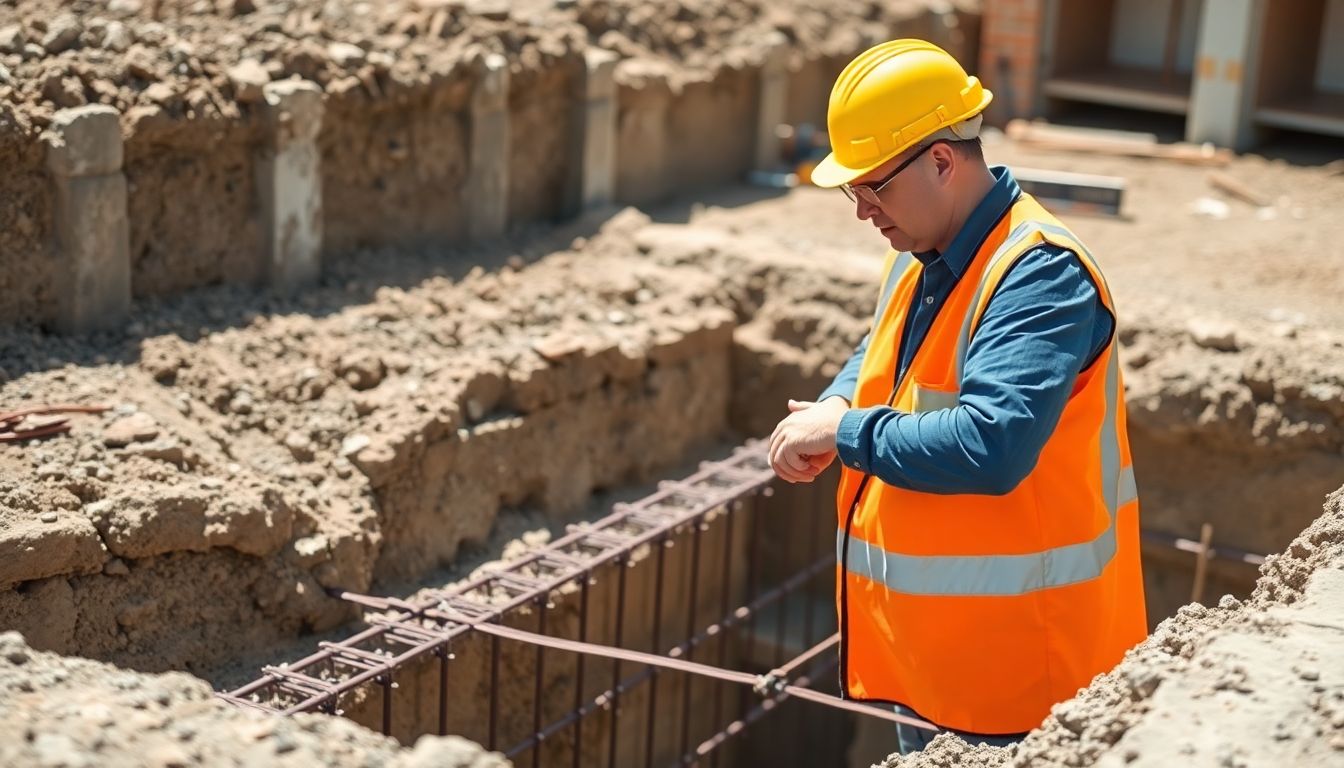
- Photographs of formation, reinforcement, cover, and the completed pour.
These records are your proof the foundation was built correctly — and the only way to demonstrate it once everything is buried.
Why photographs matter so much here
Because foundations are concealed, photographs of the reinforcement, cover, and formation taken at the pre-pour stage are irreplaceable. If a question ever arises about what's in the ground, those images are the only evidence. Capture them deliberately and keep them with the inspection record.
Capturing it digitally
A site inspection app lets you complete the foundation checklist on a tablet at the excavation, attach the critical pre-pour photos to each item, capture the sign-off, and hold it all against the specific foundation — so the full, photo-backed record exists before the concrete truck arrives.
Key takeaways
Foundation inspection is a critical hold point because defects are concealed by the pour. Check setting out and excavation, confirm the founding stratum, and rigorously inspect reinforcement, cover, and formwork before concrete. Verify the mix at delivery, control placing and curing, and — above all — keep photographs of the concealed work. It's the one record you can never recreate.
Free download · no email required
Foundation Inspection Checklist
Excavation, reinforcement and pour checks before concrete goes in and the work is buried.
How to use it
- This is the highest-consequence inspection on most projects, because everything after it is buried and expensive to expose.
- Do not let the pour start until the reinforcement inspection is released in writing. A verbal release is worth nothing afterwards.
- Record the actual measurement for cover and spacing, not a tick. The number is what the engineer needs.
- Photograph the reinforcement from enough angles to identify the grid location later. Photographs of anonymous rebar prove nothing.
- Keep the delivery tickets with this sheet — mix, time and slump are the first things queried if cube results fail.
Prefer not to retype it? SiteAudit runs this on your phone offline, attaches photos to every line and exports a signed PDF before you leave site. See all templates.
Get the Site Audit app
Capture issues, generate reports and finish audits faster — right from your phone.


Site Audit is a free construction site audit app for contractors — download the app or see pricing.